Against the backdrop of advancing global energy transition and steady progress toward the "dual carbon" goals, the new energy vehicle and energy storage industries are experiencing explosive growth and embarking on a fast track of high-quality development. As the "power heart" of the new energy industry, the safety, reliability and service life of power batteries directly determine the market competitiveness of end products, and are even more critical to public safety and the foundation of industrial development. To this end, domestic and foreign mandatory and recommended standards such as GB 38031, IEC 62660, and UL 1642 have been issued successively, establishing stringent "safety access thresholds" and "performance evaluation yardsticks" for power batteries. Among these, thermal shock testing, as a core experiment to verify batteries' environmental adaptability to extreme temperature fluctuations, structural integrity and safety stability, can accurately expose potential safety hazards caused by mismatched thermal expansion and contraction of components such as electrodes, separators and packaging shells. It is an indispensable key link in the R&D, certification and mass production of power batteries. With forward-looking technological layout, deeply customized testing solutions and profound industry expertise, Lab Companion has become a core partner of leading enterprises in the new energy industry chain, jointly building a solid testing and verification barrier for the safety and reliability of power batteries, and escorting the high-quality development of the industry.
Standards as the Guideline: Stringent Core Dimensions of New Energy Power Battery Testing
The power battery testing and certification system is both complex and rigorous, and thermal shock testing is a key stress test to measure batteries' environmental adaptability and define their safety boundaries. It runs through the entire process of battery R&D, certification and mass production, and all standards impose extremely stringent requirements on testing conditions, equipment precision and data reliability.
1. Mandatory Assessment Items in National Safety Standards
China's mandatory national standard GB 38031-2020 Safety Requirements for Traction Batteries for Electric Vehicles clearly lists temperature cycling, seawater immersion and other items as core testing projects. Temperature cycling mainly simulates the slow temperature changes in daily vehicle use, while thermal shock testing, as a more stringent verification method, can achieve rapid temperature conversion from -40℃ to +85℃. It is mostly used in the battery R&D stage to accurately verify the tightness, insulation and structural stability of batteries under extreme temperature fluctuations, and detect fatal safety hazards such as thermal runaway in advance to uphold the bottom line of power battery safety.
2. Core Verification Items for Reliability and Service Life
International general specifications such as the UN38.3 transportation standard in the Recommendations on the Transport of Dangerous Goods - Manual of Tests and Criteria and the IEC 62660 performance standard for lithium-ion traction batteries for electric road vehicles all include thermal shock and rapid temperature change testing as mandatory items. By simulating extreme temperature fluctuation scenarios in the full cycle of battery transportation, storage and use, these tests comprehensively evaluate key indicators such as capacity attenuation, internal resistance change and functional integrity of batteries, ensuring the stable operation of power batteries under various complex working conditions and guaranteeing their service life and operational reliability.
3. Essential Passport for International Market Access
For power batteries to enter the global market, they must meet stringent certification requirements of corresponding regions: access to the North American market requires UL 1642 (lithium battery cells) or UL 1973 (energy storage systems) certification, and the EU, Japan, South Korea and other regions also have corresponding special testing standards. All types of certifications clearly include temperature cycling and thermal shock testing requirements for battery cells and modules. Only by passing high-standard testing and verification can enterprises obtain the "entry ticket" to the international market and expand their global layout.
Lab Companion Customized Solutions: Professional Tools to Solve Pain Points in Battery Safety Testing
New energy power battery testing is characterized by high risk, high precision and high stringency, and ordinary general-purpose testing equipment can no longer meet industry demands. Focusing on the core pain points of battery testing and deeply engaged in technological R&D, Lab Companion has launched high-safety, high-precision thermal shock testing solutions tailored exclusively for power batteries, which are fully applicable to the testing needs of all categories including cells, modules and PACKs, building a dual barrier for testing safety and data accuracy.
1. Intrinsically Safe Design to Build a Firewall for Testing Safety
During power battery testing, short circuits, liquid leakage, thermal runaway and other safety risks are likely to occur due to internal defects. Lab Companion's special thermal shock chambers for batteries adopt multiple intrinsically safe protection designs to eliminate potential safety hazards from the source and fully protect the laboratory environment and operators.
• Explosion-Proof and Corrosion-Resistant Structure: The inner tank and air duct of the test chamber are made of high-quality anti-static and corrosion-resistant materials, and an enhanced explosion-proof reinforced design is available as an option. The special pressure relief outlet is directionally guided to a safe area, which can effectively control risks and avoid the spread of safety accidents even in case of sudden abnormalities.
• Intelligent Global Monitoring: Equipped with multiple high-precision sensors to monitor the concentration of smoke and flammable gas (optional) in the chamber in real time, and deeply linked with the intelligent fire protection system. Once abnormal data is detected, the equipment can immediately cut off the test power automatically and start the internal spray or inert gas protection device (customized configuration) simultaneously, realizing a second-level risk response.
• Special Safety Accessories: Equipped with customized insulated and high-temperature resistant battery trays and fixtures, matched with special anti-short circuit and anti-arc electrical connection interfaces to standardize the test wiring process, eliminate wiring hidden dangers, and ensure the entire testing process is safe and secure.
2. Precise Temperature Control and Uniform Temperature Field to Ensure the Validity of Test Results
Power battery testing has extremely high requirements for temperature field uniformity and temperature control precision, and even a slight temperature deviation will affect the accuracy of test results. Relying on core hard technologies, Lab Companion's thermal shock chambers achieve precise stress application, ensuring that every battery cell and every module is in a consistent testing environment and guaranteeing authentic and effective test results.
• High-Uniformity Temperature Field: Adopting a three-dimensional circulating air duct optimized by CFD (Computational Fluid Dynamics) design to break the pain point of uneven temperature field in traditional equipment. Within the wide temperature range of -40℃ to +85℃, the temperature uniformity of the test area is accurately controlled within ≤±2℃, avoiding inconsistent testing conditions of single battery cells caused by temperature differences, and ensuring the consistency and reference value of test results.
• Wide Temperature Range and Rapid Thermal Shock: The equipment can cover an ultra-wide temperature range from -70℃ to +150℃, fully adapting to the testing needs of all categories such as low-power consumer batteries, high-power automotive-grade batteries and energy storage batteries. Equipped with high-efficiency cooling and heating dual systems, it realizes rapid temperature conversion and fast stabilization, strictly conforms to the temperature profile requirements specified in various standards, and restores real extreme temperature fluctuation scenarios.
• Full-Process Data Traceability: Automatically records core data such as test temperature, duration and equipment operating status throughout the process. It can be externally connected to a BMS system or data acquisition equipment synchronously to collect key parameters such as battery voltage and cell temperature in a linked manner, forming a complete and traceable test data chain, providing authoritative and solid data support for product certification and R&D optimization.
3. Covering the Full Life Cycle and Adapting to Diverse Testing Scenarios
Lab Companion's thermal shock testing solutions are deeply tailored to the full life cycle testing needs of power batteries, comprehensively helping enterprises control product quality and empowering the entire process from R&D to mass production.
• Cell R&D Verification: Conduct reliability screening and failure analysis for battery cells with new material systems such as solid electrolytes and high-nickel cathodes, assisting enterprises in overcoming technical bottlenecks, optimizing cell design and improving the efficiency of new product R&D.
• Module and PACK Testing: Carry out thermal shock testing on battery modules and complete battery packs to comprehensively evaluate the performance of structural connection stability, thermal management system efficiency, insulation performance and BMS function under extreme temperature fluctuations, verifying the reliability of the entire package product.
• Production Line Quality Screening: Before battery packs leave the factory, conduct environmental stress screening through short-term high-intensity thermal shock to accurately eliminate products with potential process defects, strictly control ex-factory quality, reduce after-sales risks in the market, and build a solid product quality barrier.
Beyond Equipment Supply: Building a Full-Chain Battery Safety and Reliability System
Lab Companion has always abandoned the positioning of a single equipment supplier. Based on the development needs of the new energy industry, it is committed to providing customers with full-chain and systematic testing services, creating an integrated solution of "equipment + solutions + services" to deeply empower the upgrading of customers' testing systems.
• Professional Solution Consultation: With years of in-depth industry experience, we help customers accurately interpret complex domestic and foreign standards such as GB, IEC and UL, and customize a full-process verification plan from cells to PACKs, from safety verification to reliability testing, solving industry pain points such as difficult standard interpretation and chaotic plan planning.
• Joint Calibration and Optimization: Work hand in hand with enterprise customers and third-party authoritative testing institutions to deeply participate in the establishment and optimization of testing methods, ensuring that testing conditions not only meet the mandatory requirements of standards, but also accurately stimulate potential product defects, improving the pertinence and effectiveness of testing.
• Smart Laboratory Integration: The equipment can be seamlessly connected to the laboratory management system, realizing the whole-process digital management of test task issuance, automatic data collection and test report generation, greatly improving testing efficiency, simplifying testing processes, and ensuring data quality and management standardization.
Conclusion: Uphold the Safety Bottom Line with Professionalism, Protect the Energy Future with Ingenuity
The safety and reliability of power batteries are the core lifeline for the steady and long-term development of new energy vehicles and energy storage industries, as well as the fundamental guarantee for the high-quality development of the industry. With a reverence for the safety bottom line, Lab Companion is deeply engaged in the field of battery testing. With profound industry insights, core technical strength and stringent quality control, we create professional, reliable and safe thermal shock testing solutions. What we provide is not only a testing equipment that meets standards, but also a heavy safety commitment, an unbreakable quality guarantee, and a responsibility to boost industrial development.
Choosing Lab Companion means choosing a professional partner that deeply understands the risks and challenges of battery testing, knows the industry and meets customer needs. In the future, Lab Companion will continue to deepen technological innovation and product iteration, build a solid safety barrier for every power battery put on the market with the most stringent testing standards and professional testing equipment, and join hands with industrial chain partners to promote the high-quality and sustainable development of the new energy industry, injecting solid and reliable "core strength" into the future of global clean energy.
Driven by the global surge in intelligent driving and automotive electrification, the modern automotive industry has undergone a profound transformation, with every passenger vehicle, commercial vehicle and new energy model now equipped with hundreds of electronic control units (ECUs), integrated circuits, high-performance chips and smart electronic components. These core electronic parts act as the "brain" and "nerve endings" of the vehicle, and their long-term reliability, operational stability and durability directly determine driving safety, passenger experience and the overall performance of the entire vehicle. Even minor failures of these automotive electronics can lead to serious safety hazards, vehicle malfunctions and massive brand reputation risks in the fiercely competitive global automotive market.
As the authoritative integrated circuit stress test and qualification standard formulated and released by the Automotive Electronics Council, AEC‑Q100 has become the globally recognized benchmark for screening qualified chip suppliers and validating automotive-grade electronic components across the entire automotive supply chain. Among all the mandatory test items specified in the standard, temperature cycling and temperature shock testing stand out as core evaluation procedures, which are designed to verify a chip’s ability to endure extreme and frequent temperature fluctuations throughout the vehicle’s service life. The rigor of testing procedures, the accuracy of test data and the reliability of test results often hold the decisive vote in whether a chip can pass automotive-grade qualification and be officially applied in mass-produced vehicles.
Lab Companion is a professional manufacturer dedicated to the R&D, production and sales of thermal shock test chambers, with in-depth deployment and rich service experience in the global automotive industry chain. Relying on our profound understanding of the AEC‑Q100 standard, precise engineering implementation capabilities and mature automotive testing solutions, we provide chip design companies, semiconductor manufacturers and Tier‑1 automotive component suppliers with reliable, compliant and high-performance test equipment and supporting services, paving a smooth path for their automotive-grade certification and market entry.
AEC‑Q100: A Rigorous and Comprehensive Framework for Automotive-Grade Reliability Qualification
It is crucial to clarify that AEC‑Q100 is not a single simplified test, but a complete, systematic and strict reliability qualification system tailored for automotive integrated circuits, covering multiple stress tests to simulate harsh actual operating environments. The standard clearly lists temperature cycling (TC), highly accelerated temperature and humidity stress test (THB) and other key stress tests as mandatory items, leaving no room for compromise in automotive electronic component validation.
To adapt to the diverse operating scenarios of automotive chips, the AEC‑Q100 standard classifies chips into different grades based on their operating temperature ranges, corresponding to various application scenarios inside the vehicle such as engine compartments, cockpits and chassis electronic cabins. The representative grades include:
• Grade 0: Ultra-high temperature resistance grade, applicable to high-temperature harsh environments, with an operating temperature range of -40℃ to +150℃
• Grade 1: High-performance general automotive grade, with an operating temperature range of -40℃ to +125℃
Beyond grade classification, the AEC‑Q100 standard also stipulates detailed and non-negotiable test conditions to ensure the authenticity and effectiveness of stress simulation:
• Test method: Based on the JEDEC JESD22‑A104 standard temperature cycling test specifications, while automotive-grade applications impose more stringent, upgraded requirements to fit the extreme actual vehicle operating environments.
• Temperature range: Must fully cover the complete operating temperature range defined in the chip specification, as well as the upper and lower limit extensions, to simulate extreme temperature scenarios beyond conventional working conditions.
• Cycle times: Generally requiring 500 to 1000 consecutive temperature cycles, aiming to accelerate and simulate the repeated temperature alternating stress that chips endure during the entire vehicle life cycle of 10-15 years.
• Transition rate and dwell time: The standard has clear and rigid regulations on the temperature change rate and the stable dwell time at high and low temperatures, ensuring that sufficient thermal stress is fully applied to the chip to expose potential defects effectively.
The ultimate core goal of this series of tests is to reveal potential failures that may occur in chip packaging, solder joints, internal interconnection structures and other key parts under repeated thermal expansion and contraction, such as physical cracks, structural delamination, electrical performance drift and functional failure. Any deviation of test equipment, loose process control or inaccurate data recording may lead to missed defect detection or false judgment, which will bring huge quality risks, recall losses and legal liabilities to automotive manufacturers and component suppliers.
Lab Companion Solutions: Precision Alignment with AEC‑Q100 Test Requirements
Facing the strict and detailed requirements of the AEC‑Q100 standard, Lab Companion’s thermal shock test chambers are designed and manufactured with full standard compliance and ultimate test validity as dual core priorities, providing hierarchical, customized and high-adaptability solutions for different automotive electronic testing scenarios, fully meeting the certification needs of various automotive chips and electronic components.
1. Basic Compliance: Full Temperature Range Coverage & Whole-Process Traceability
The foundation of passing AEC-Q100 certification lies in the basic compliance of test equipment, and Lab Companion’s thermal shock chambers excel in this regard with outstanding performance:
• Ultra-wide precise temperature range: The standard temperature zone of the equipment covers -70℃ to +180℃, which can easily meet the temperature range requirements of all grades from Grade 0 to Grade 3, and supports personalized custom expansion according to the specific specifications and special testing needs of customer chips, covering all automotive-grade temperature test scenarios.
• Controllable temperature transition and dwell: The equipment achieves a fast temperature transition of ≤10 seconds, breaking the limitations of traditional equipment in temperature conversion efficiency. At the same time, it allows users to accurately set the high and low temperature dwell time (usually 10-30 minutes), fully complying with JEDEC JESD22‑A104 specifications and more stringent customer-defined test profiles, ensuring the standardization of testing processes.
• Complete data integrity and traceability: Equipped with a high-precision intelligent data recording system, it can record and store time-stamped temperature curves, real-time cycle times, equipment operating status and other key data throughout the entire test process. The generated test data reports are standardized in format, with clear and detailed parameters, which can be directly used as certification submission materials, fully meeting the core requirements of ISO 17025 accredited laboratories for test process auditability and full traceability.
2. Advanced Empowerment: Adapting to Complex Automotive-Grade Test Scenarios
For the complex and diversified testing needs of high-end automotive electronics such as intelligent driving chips, vehicle-mounted controllers and power semiconductors, Lab Companion’s thermal shock chambers provide advanced customized functions to break through the limitations of conventional testing:
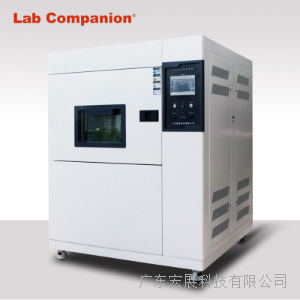
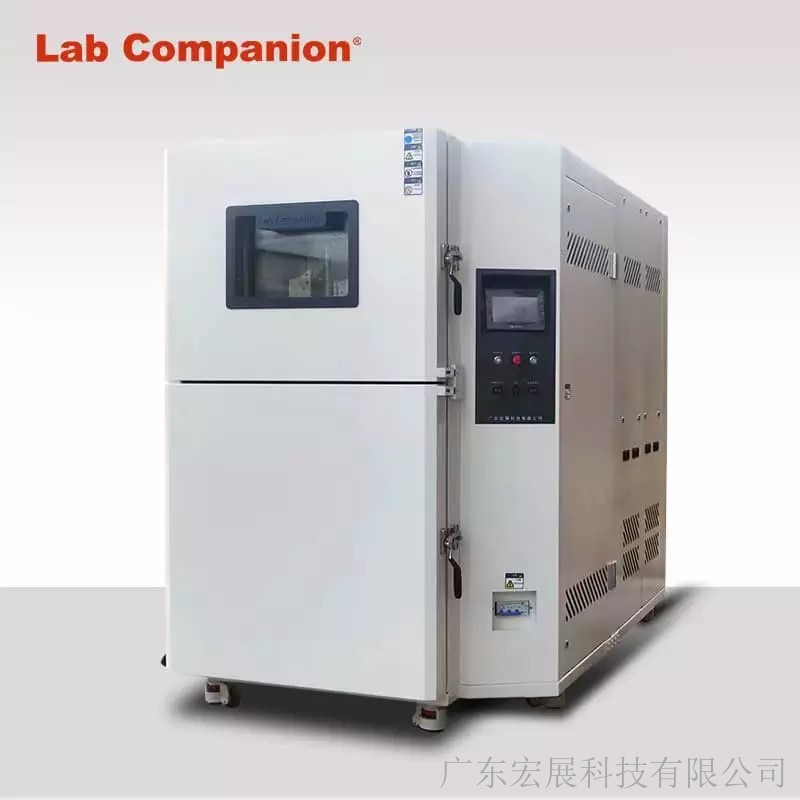
• Three-zone static testing mode: For ECUs, MCUs, smart sensors and other components that require continuous power-on and real-time functional monitoring during testing, Lab Companion’s three-zone thermal shock chamber is the optimal choice. The sample remains stationary throughout the test, and temperature airflow is switched through high-speed air dampers, completely eliminating vibration interference caused by sample transfer in traditional basket-type equipment, ensuring the stability and accuracy of functional test signals and avoiding test errors caused by external vibration.
• High-power load and power-on test integration: For high-heat components such as motor controllers and vehicle-mounted power modules, the equipment adopts an enhanced air duct design and optimized air circulation system, ensuring uniform temperature field even under high-load operation. In addition, it can safely integrate high-current wiring terminals and professional signal interfaces, realizing real loaded temperature shock testing that fits the actual operating state of automotive electronics, restoring real vehicle working conditions to the greatest extent.
• Multi-channel monitoring and failure analysis assistance: The equipment supports the expansion of multi-channel temperature monitoring points, which can track and monitor the temperature response of key parts of the sample in real time. When the chip functional failure occurs during the test, the accurate temperature change timing data and detailed test records can provide key clues and data support for subsequent failure physical analysis (FA), helping customers quickly locate failure causes and optimize product design and processes.
Beyond Equipment: Building a Trust Foundation for Automotive-Grade Reliability
Lab Companion deeply understands that passing AEC‑Q100 certification is not just about completing a series of test items, but more about building a complete, reliable and internationally recognized quality trust system for automotive electronic products. Therefore, our services extend far beyond the supply of single test equipment, covering the entire chain of automotive-grade reliability verification:
• Standard consultation and test plan optimization: Relying on years of industry experience and in-depth research on AEC-Q100 standard updates, we assist customers in accurately interpreting the latest version requirements of AEC‑Q100, and optimize test profiles and test procedures combined with customer product characteristics. On the premise of ensuring the validity of certification, we explore more efficient and cost-effective test methods to help customers shorten the certification cycle and reduce verification costs.
• Metrology and calibration assurance: We provide regular calibration services traceable to national metrology standards (NIST-traceable), with professional calibration procedures and authoritative calibration certificates. This ensures the long-term stability of equipment parameters and measurement accuracy, which is the fundamental prerequisite for producing authoritative and credible certification data, eliminating data deviations caused by equipment accuracy problems.
• Reliability verification ecological support: Lab Companion’s thermal shock chambers can be used as the core equipment of the customer's overall reliability verification laboratory, and can be seamlessly linked with HAST (highly accelerated temperature and humidity stress test) chambers, vibration test benches, environmental test chambers and other supporting equipment. It forms a complete automotive-grade reliability verification system, covering all-round stress tests such as temperature, humidity and vibration, helping customers build a one-stop automotive electronic reliability verification platform.
Conclusion: Precision Thermal Testing Safeguards the Future of Intelligent Mobility
AEC‑Q100 certification is an indispensable threshold for automotive chips and electronic components to enter the global automotive market, and also an extreme test of product design, manufacturing process and quality control. Lab Companion relies on thermal shock test solutions highly compatible with AEC‑Q100 standards, and has become an indispensable reliability engineering partner behind many chip design companies and automotive component suppliers worldwide.
What we provide is not just a device that can achieve extreme temperature changes, but a standardized verification environment with high controllability, reliable data and compliant processes. Every chip and electronic component undergoes rigorous temperature tests simulating the entire vehicle life cycle here, undergoing extreme thermal stress tempering. Only the most reliable and high-quality products can stand out, be equipped in the next generation of intelligent vehicles, and drive safely towards the future of smart mobility.
Choose Lab Companion, and choose precision and reliability for your automotive-grade certification journey.
I. Temperature-related Issues
Failure to reach set temperature: Check operation of heater/compressor, replace if damaged; calibrate sensor, replenish refrigerant if leaking; replace aging sealing strips.
Slow shock rate: Clean air duct filter/condenser dust; inspect fan and switching valve, lubricate or replace if stuck.
Large temperature fluctuation: Calibrate thermostat PID parameters; reduce sample load (≤30% of chamber volume), place evenly without blocking air ducts.
II. Refrigeration-related Issues
Slow cooling in low-temperature zone: Clean condenser fins; detect leaks and replenish refrigerant; activate defrost program or replace expansion valve.
Frequent compressor on/off: Stabilize power supply voltage, improve equipment room ventilation; replenish refrigerant or replace refrigeration oil.
High-pressure alarm: Clean condenser and inspect cooling fan.
III. Mechanical-related Issues
Poor door sealing: Adjust door latch, replace aging sealing strips; calibrate chamber levelness.
Stuck transfer mechanism: Clean guide rail debris and lubricate; calibrate position sensor.
Abnormal noise (fan/valve): Add lubricating grease, replace worn bearings; clean valve impurities.
IV. Electrical-related Issues
Failure to start: Reset emergency stop button, inspect power supply/air switch; rewire if grounding is poor.
Abnormal display: Reconnect cable, test power module; restore factory settings after backing up parameters.
Alarm code triggered: Troubleshoot per code prompt (e.g., E1 overheating: check heater/sensor); contact manufacturer for repeated alarms.
V. Key Notes
Power off before troubleshooting; refrigeration system maintenance requires professional operation.
Clean filter weekly, inspect seals monthly, and calibrate sensor annually.






 Obtenez un devis
 Réseau IPv6 pris en charge